
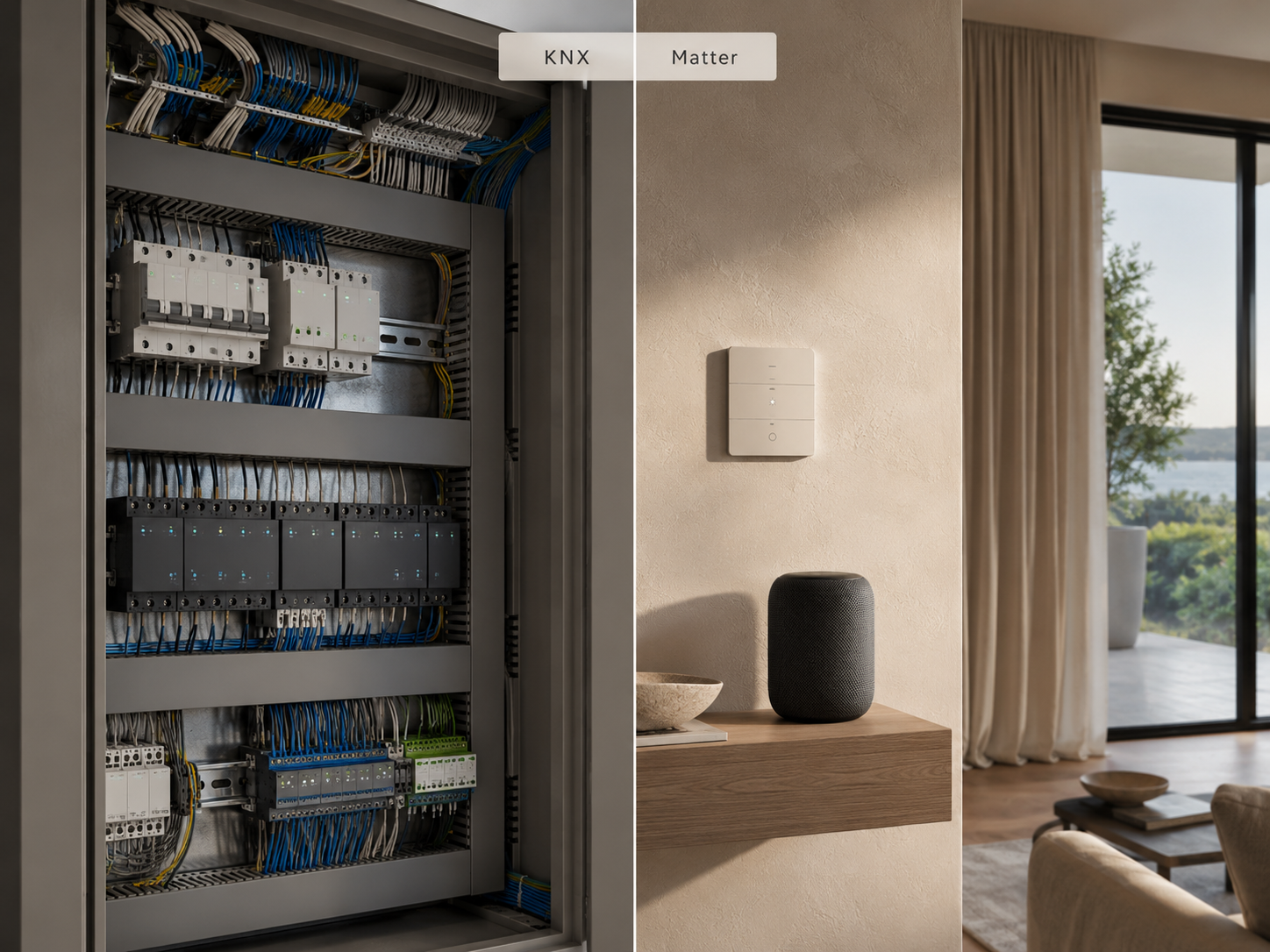
KNX vs Matter: Which Smart Home System Is Right for Your Australian Build in 2026?
- by Arklyfe Team

Short answer for Australian builders, architects and homeowners in 2026: choose KNX wired when you are building a new home from scratch, renovating down to bare walls, or running a multi-zone commercial project where 25-year reliability, sub-50ms response times, and full local control matter more than upfront cost - typical investment AU$15,000-60,000+. Choose Matter over Thread when you want flexible upgrades, multi-ecosystem control (Apple/Google/Alexa), retrofit without rewiring, or are working in an existing home - typical investment AU$2,000-10,000. Many Australian luxury builds in 2026 actually combine both: KNX wired backbone for lighting, blinds, HVAC and security in the core areas; Matter over Thread for flexible add-on devices, guest rooms, and outdoor sensors. Arklyfe designs and installs both systems across Victoria - see our KNX wired smart home solution or end-to-end smart home solutions for a hybrid approach.
KNX is an open, standardised wired bus protocol developed in 1990 in Europe and now governed by the KNX Association in Brussels. It runs on a low-voltage 2-wire bus (24V DC) that connects every smart device in your home - switches, dimmers, sensors, blind motors, HVAC controllers, security panels - to a single decentralised network.
In Australia, KNX is the standard system specified by architects and electrical engineers for:
It is supported by 500+ certified manufacturers worldwide (Jung, Gira, Schneider, ABB, Siemens, Hager, MDT). Devices from any KNX-certified brand interoperate, and once installed, the system can be reprogrammed via ETS software without rewiring.
Matter is a wireless application-layer standard launched in 2022, backed by Apple, Google, Amazon and Samsung. It runs over Thread (a low-power 2.4 GHz mesh radio) or Wi-Fi, and works natively with Apple Home, Google Home, Alexa and SmartThings on the same device.
We covered Matter in depth in our Matter vs Zigbee vs Z-Wave guide. The short version: it's the best wireless option in 2026 for new homes, retrofits, and renters who want smart home control without commitment.

| Criterion | KNX wired | Matter over Thread |
|---|---|---|
| Year established | 1990 (KNX standard) | 2022 (Matter 1.0) |
| Medium | 2-wire bus (24V DC) | Wireless 2.4 GHz mesh + Wi-Fi |
| Reliability | Industrial grade, < 50 ms response | 50-150 ms typical, depends on mesh density |
| Installation | New build / full rewire only | Retrofit-friendly, no cabling needed |
| Lifespan | 25+ years documented | Too new - projected 10+ years |
| Local control | 100% local, no cloud | Local-first, cloud optional |
| Upfront cost (3-bed home) | AU$15,000-35,000 | AU$2,000-6,000 |
| Upfront cost (5-bed luxury) | AU$40,000-80,000+ | AU$8,000-15,000 |
| Ongoing cost | Effectively zero | Effectively zero (some cloud cameras optional) |
| Hub required | No (decentralised) | One Thread Border Router (HomePod, etc.) |
| App / control method | Custom dashboards via KNX visualisation servers | Native Apple Home, Google Home, Alexa, SmartThings |
| Architect / specifier preference | Standard for premium builds | Growing rapidly |
| Resale value | High (KNX is a documented feature) | Moderate (still a "nice to have") |
| Best for | Building from bare walls | Existing homes + flexible add-ons |
| Worst for | Renters, completed homes | 30+ zone commercial, mission-critical lighting |
This is the only moment KNX makes economic sense at residential scale. Cabling is dropped in with electrical rough-in. Once the gyprock is on, retrofit becomes punishingly expensive.
Walls open, ceilings out - same logic as new build. Adding a KNX bus to your rough-in adds AU$3,000-6,000 in materials but unlocks the entire ecosystem.
Below 3 bedrooms / single living area, the per-zone cost of KNX is hard to justify against Matter. Above that, KNX scales linearly while wireless mesh starts degrading.
KNX is specified by name in luxury real estate listings in Australia. Matter is not yet.
Cinema rooms, wine cellars (see our wine cooler range), commercial kitchens, aged-care lighting, security-critical zones - anything where a 200ms hiccup or Wi-Fi dropout is unacceptable.
KNX talks directly to building management systems, multi-split air-conditioning controllers, and large-scale lighting DALI gateways. Matter does not yet.
For most Australian existing-home owners in 2026, Matter is the right answer - see our SAA-certified Matter switch range.
Real-world reality: pure KNX-only builds are rare in 2026. Most premium projects combine both:
| System | Used for |
|---|---|
| KNX wired backbone | Core lighting circuits, motorised blinds, HVAC zones, security, heated towel rails, scene keypads |
| Matter over Thread (added on KNX) | Guest bedrooms, outdoor sensors, smart bulbs in seasonal areas, future device additions, voice-control bridges to Apple/Google/Alexa |
Why this works: - KNX handles the non-negotiable systems that must work for 20+ years with sub-50ms response - Matter handles the flexible systems that benefit from voice control and multi-ecosystem compatibility - A KNX gateway brings the wired bus into Apple Home / Google Home if the owner wants voice control of everything
We design hybrid systems through our smart home solutions consultancy.

| Component | Approx. cost (AU$) |
|---|---|
| KNX bus power supply + IP gateway | $1,200 |
| 30 × KNX scene keypads / switches (Jung or Gira) | $9,000 |
| 12 × KNX dimming actuators (multi-channel) | $4,800 |
| 8 × KNX motorised blind actuators | $2,400 |
| 6 × KNX HVAC controllers | $1,800 |
| 12 × presence / temperature sensors | $1,800 |
| KNX visualisation server + custom dashboard | $3,500 |
| ETS programming and commissioning | $4,000 |
| Licensed electrical install (KNX-certified) | $8,500 |
| Total | AU$37,000 |
Equivalent Matter over Thread project: AU$8,500-12,000 - but without the 25-year guarantee, sub-50ms response, or KNX visualisation flexibility.
For larger 5+ bedroom builds, KNX projects can comfortably reach AU$60,000-80,000.
If you're at architectural design stage, talk to us via our partner programme - we work with builders and architects to design KNX systems from blueprints up.
"KNX is European, it won't work here." False. KNX is a worldwide standard, all major brands certify for AU 230V / 50Hz and ship with SAA approval through Arklyfe.
"KNX is obsolete now that Matter exists." False. KNX has been the dominant European luxury smart home protocol for 30+ years and remains the specification of choice for new luxury builds in 2026. Matter solves different problems.
"KNX requires a permanent internet connection." False. KNX runs entirely locally on its own bus. No cloud, no internet, no subscriptions.
"It's too expensive." True at the low end (under AU$15,000 budgets), false at the high end - for a AU$3M+ home build, AU$40,000 on KNX is < 2% of total budget and adds documented resale value.
"I have to commit to one ecosystem." False. KNX can be bridged to Apple Home, Google Home, Alexa and SmartThings via gateways. You get the wired backbone PLUS the voice ecosystems.
| Your situation | Recommended system |
|---|---|
| New build, 4+ bedrooms, luxury finish | KNX wired backbone + Matter add-ons |
| New build, 3 bedrooms, mid-market | Matter over Thread, KNX optional |
| Major renovation, walls open | KNX wired backbone if budget allows; otherwise Matter |
| Existing 3-bedroom home | Matter over Thread only |
| Apartment / rental | Matter over Thread only |
| Hotel / commercial fitout | KNX wired (rarely anything else makes sense) |
| Aged-care facility | KNX wired |
| Heritage home (no rewire allowed) | Matter over Thread only |
1. Can KNX talk to Apple Home / Google Home / Alexa in Australia? Yes - through a KNX IP gateway. You get the wired KNX backbone with the option to add voice control via any major ecosystem.
2. How long does KNX installation take for a 4-bedroom Melbourne build? Cable rough-in adds 2-3 days to standard electrical work. Device installation, programming and commissioning typically takes 4-8 working days depending on complexity. Best scheduled with your electrician's first and second fixes.
3. Is KNX more secure than Matter? Both can be secure. KNX runs on a physical bus - an attacker would need physical access to your cabling. Matter uses end-to-end encryption over wireless. For high-security applications (high-net-worth homes, embassies), KNX is typically preferred.
4. Can I add KNX to an existing Australian home without major renovation? Generally no - the bus needs to run through walls and ceilings. Some partial retrofits work via KNX RF (wireless KNX) but at much higher per-device cost than wired. For existing homes, Matter is almost always the better answer.
5. Does Arklyfe install KNX? Yes. We design and install KNX systems across Victoria and partner with KNX-certified electricians in NSW and QLD. Start with our KNX wired smart home solution overview or contact our team for a site assessment.
If you are planning a new build or major renovation in Victoria and want a no-obligation KNX feasibility assessment, talk to our team via /pages/our-services. For everything else, our Matter over Thread smart switch range is the cleanest entry point to Australian smart home automation.
Last updated: 2026-05-28. Arklyfe is a Melbourne-based smart home retailer and integrator specialising in SAA-certified KNX wired systems and Matter over Thread devices for Australian luxury residential and commercial projects.
Matter over Thread Smart Switches in Australia: 2026 Buyer's Guide
Clipsal vs Matter Smart Switches: An Honest Comparison for Australian Homes
Smart Light Switches in Australia: The Complete Guide
Share:
Smart Home Cost in Australia 2026: Full Pricing Breakdown (AU$500 to AU$20,000)
Smart Light Switches in Australia: The Complete Guide